
Want a More Innovative Team? Start Celebrating Failure
Most corporate executives would disagree with what I’m about to say, but hear me out:
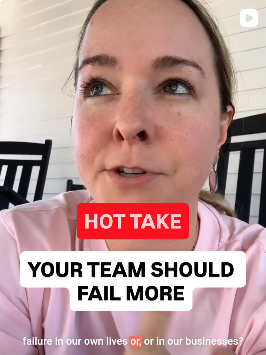
One of the best ways to grow your business might be to celebrate failure.
Not careless mistakes. Not a lack of preparation. And definitely not repeating the same mistake over and over.
I’m talking about the kind of failure that happens when someone takes a thoughtful risk, experiments with a new idea, or pushes beyond the limits of what they already know how to do.
If you want to create a culture of innovation, your team needs to know that kind of failure is safe.
What the Gym Taught Me About Failure
I recently started working with a trainer at the gym. During one of our workouts, she had me doing leg presses.
We completed a warm-up set, followed by a more difficult set. Then she loaded the machine with what felt like an absolutely insane amount of weight.
I started pressing and gave it everything I had. But by the final two repetitions, she had to help me finish.
I was frustrated. I immediately started beating myself up because I couldn’t complete the set on my own.
Then she stopped me and said, “Wait, Holly. Yes, failure. That’s what we’re going for.”
That completely changed the way I saw the experience.
At the gym, failure didn’t mean I was weak or incapable. It meant I had pushed myself to the edge of my current capacity. My muscles now had a reason to adapt and grow.
It made me wonder: How often do we celebrate that kind of failure in our businesses?
Innovation Requires the Freedom to Get It Wrong
Leaders often say they want their organizations to be innovative.
They want employees to take initiative, solve problems, bring forward new ideas, and find better ways of doing things.
But innovation and experimentation can’t be separated. (I talk more on this concept in this blog: The Strategic Yes: Why Great Leaders Move Before Every Detail Is Guaranteed)
When people try something genuinely new, there will always be a chance that it won’t work. If every unsuccessful attempt is treated like a performance problem, people quickly learn that taking risks isn’t worth it.
They stop offering unconventional ideas.
They wait for the leader to make every decision.
They protect themselves by doing only what they already know will work.
Eventually, the organization may still talk about innovation, but the team begins operating from fear.
You can’t build a culture of innovation if everyone is terrified to get something wrong.
How Leaders Respond to Failure Shapes the Culture
I’ve always loved the story Sara Blakely tells about growing up. Around the dinner table, her dad would ask what she had failed at that week.
If she didn’t have an answer, he was disappointed. To him, a lack of failure meant she probably hadn’t tried anything new.
That question changed the meaning of failure. It was no longer something embarrassing that needed to be hidden. It became evidence that she had been brave enough to stretch herself.
Leaders have the same opportunity with their teams.
Your response when something doesn’t go as planned teaches people what is truly valued in your organization.
Do you immediately look for someone to blame?
Do you react with frustration before asking what happened?
Does the person who took the risk regret telling you about it?
Or do you create enough space to understand the decision, examine the result, and apply what the team learned?
Your team is always watching your reaction. Over time, those reactions become the culture.
Celebrating Failure Doesn’t Mean Ignoring Accountability
Creating a safe environment for experimentation doesn’t mean lowering your standards.
There is a difference between a thoughtful risk and a careless decision.
Healthy teams still expect people to prepare, communicate, take responsibility, and use good judgment. They also expect people to learn from what happened rather than continuing to make the same mistake.
The goal isn’t to celebrate every negative result. The goal is to recognize the behaviors that make growth possible:
The courage to suggest a new idea
The willingness to test an assumption
The honesty to admit when something didn’t work
The humility to reflect on the outcome
The discipline to apply the lesson next time
That combination creates both psychological safety and meaningful accountability.
Your team should feel safe enough to tell the truth and responsible enough to grow from it.
Here are 5 other practical tips for leading a healthy team.
How to Create a Culture That Learns From Failure
You don’t need to launch a major company initiative to begin changing how your team thinks about failure.
Start by sharing one of your own.
At your next team meeting, talk about something you tried that didn’t go as planned. Explain why you made the decision, what happened, what you learned, and what you’ll do differently moving forward.
Then ask your team:
What have you tried recently that didn’t go as planned?
Don’t rush to correct them or explain what they should have done. Get curious first.
You can ask:
What were you hoping would happen?
What surprised you?
What did you learn?
What would you change if you tried it again?
How can we use this lesson somewhere else?
Celebrate the learning, not just the outcome.
When leaders openly discuss their own failures, they make honesty safer for everyone else. They show their teams that mistakes don’t have to be hidden and that growth matters more than maintaining the appearance of perfection.
Growth Happens at the Edge of Your Current Capacity
Most meaningful growth requires us to move beyond what is already comfortable, familiar, and proven.
That is true in the gym, in leadership, and in business.
You won’t create an innovative organization by eliminating every possibility of failure. You create one by helping people take thoughtful risks, reflect honestly, and become better because of what they learn.
So here are two questions to consider this week:
How are you challenging yourself to risk failure?
How are you creating a team where people feel safe enough to try?
The way you answer those questions may determine how much room your organization has to grow.
Build a Stronger, Healthier Team
The Ready Network helps leaders gain clarity, build stronger teams, and create healthier organizations. We’d love to work with your team on these goals. Schedule a discovery call here.
Follow The Ready Network on Instagramfor more practical leadership and productivity strategies you can apply with your team.